
Margalla Road Extension – Infrastructure Analysis & Real Estate Impact in Islamabad
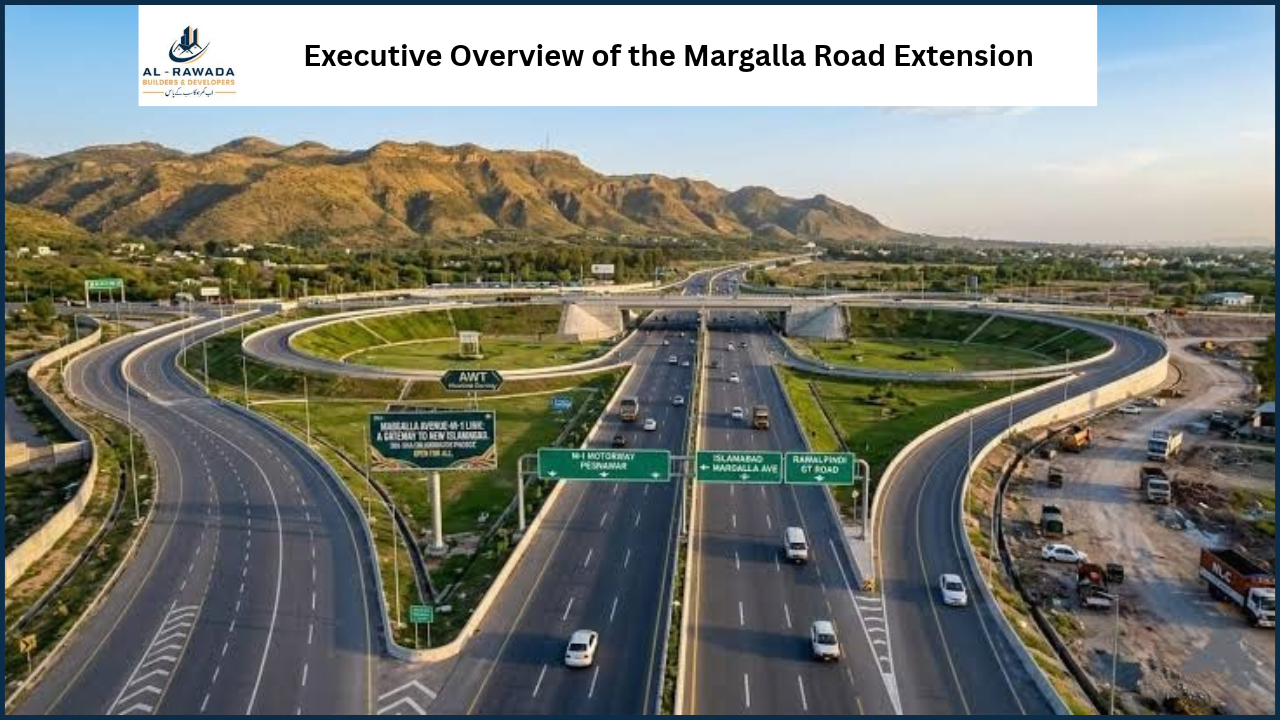
1. Introduction & Executive Overview of the Margalla Road Extension
The execution of the 5.2-kilometer Margalla Road Extension represents a critical structural turning point for Islamabad’s western sector grid and the Zone 2 urban master plan. For decades, the western periphery of the federal capital functioned as a constrained transit zone, forcing cross-city traffic through severe bottlenecks before connecting to regional intercity highways. The completion of this extension permanently transitions the corridor from a peripheral bypass territory into a primary, high-velocity urban connectivity hub. By establishing a direct arterial linkage between central Islamabad, the Grand Trunk (GT) Road (N-5), and the Peshawar Motorway (M-1), this mega-infrastructure initiative reshapes spatial accessibility, unlocks suppressed real estate liquidity, and redefines capital appreciation dynamics across the capital’s western expansion axis.
To execute this project efficiently, administrative jurisdiction and physical construction have been divided across a dual organizational framework spanning the total 5.2-kilometer alignment:
- Capital Development Authority (CDA) Jurisdiction: A 2.7-kilometer package extending from the GT Road (N-5) intersection near the Sangjani region to the Sangjani Grid Station within Islamabad’s municipal boundaries.
- National Highway Authority (NHA) Jurisdiction: A 2.5-kilometer package extending from the Sangjani Grid Station through Rawalpindi territorial limits to construct the direct link onto the M-1 Motorway near AWT Housing Society.
The fundamental administrative, financial, and physical metrics governing the project are summarized in the comparative matrix below:
| Parameters | Project Specifications |
| Total Project Length | 5.2 Kilometers (CDA Portion: 2.7 km | NHA Portion: 2.5 km) |
| Primary Route Scope | Extends Margalla Road from GT Road (N-5) near Sangjani Grid Station to M-1 Motorway near AWT Housing Society |
| Jurisdictional Breakdown | Joint Execution: Capital Development Authority (CDA) & National Highway Authority (NHA) |
| CDA Contract Value & Bidding | Awarded at PKR 3.51 Billion (10% below engineered estimate of PKR 3.58 Billion; saving ~PKR 350 Million) |
| Key Structural Features | 6-Lane Main Dual Carriageway, 2-Lane Service Road, 2 Vehicular Underpasses, 1 River Bridge, Sangjani Interchange |
| Target Completion Deadlines | Sangjani Interchange: Fast-tracked for July 31 | Overall Project Completion: December 2026 |
Having established the strategic rationale, geographic scope, and administrative distribution of the Margalla Road Extension, it is necessary to examine the specific contracting arrangements, technical engineering specifications, and construction schedules driving execution.
2. Contractor Breakdown, Technical Scope, and Project Timelines
From an institutional and capital markets perspective, rigorous execution frameworks, procurement cost efficiencies, and enforceable completion targets are indispensable for evaluating risk. Capital market investors evaluating real estate assets along the Margalla corridor rely heavily on the execution capabilities of designated contractors and strict public sector deadlines to accurately price in project realization timelines and forecast liquidity events.
[GT Road (N-5) / Sangjani Interchange]
                  │
                  ▼  (2.7 km Package - CDA / New Khan Builders)
       [Sangjani Grid Station]
                  │
                  ▼  (2.5 km Package - NHA / NLC - Traversing Punjab Limits)
   [M-1 Motorway near AWT Housing Society]
Contracting Roles and Jurisdictional Division
- CDA Portion (Executed by New Khan Builders): This 2.7-kilometer segment spans from GT Road (N-5) to the Sangjani Grid Station within federal territory. Procurement for this section demonstrated notable fiscal discipline: the CDA opened financial bids originally benchmarked at PKR 3.58 billion and awarded the contract to New Khan Builders at a lowest bid of PKR 3.51 billion. This bid came in 10% below the engineered estimate, generating approximately PKR 350 million in direct procurement savings. Federal Interior Minister Mohsin Naqvi fast-tracked the deadline for the critical grade-separated Sangjani Interchange on GT Road to July 31 to resolve localized bottlenecks, while the overall target completion date for the CDA segment is set for December 2026.
- NHA Portion (Executed by National Logistics Cell – NLC): The National Highway Authority is managing the remaining 2.5-kilometer section through its contractor, the National Logistics Cell (NLC). While NHA and NLC lead physical engineering execution, this section traverses Punjab provincial territorial limits within Rawalpindi, requiring administrative coordination with provincial authorities. Work on this segment is progressing at full scale to connect the Sangjani Grid Station terminal point directly to the M-1 Motorway in the vicinity of AWT Housing Society.
Technical Infrastructure Specifications
The engineered corridor is constructed to high-capacity arterial standards, incorporating the following technical specifications:
- Primary Dual Carriageway: A 6-lane main roadway configuration (3 dedicated lanes on each side) engineered for high-velocity throughput.
- Service Road Infrastructure: A continuous 2-lane service road facility designed to handle localized arterial access without disrupting mainline traffic flow.
- Grade-Separated Structures: Construction of 2 vehicular underpasses and 1 major river bridge to maintain continuous signal-free movement.
- Interchange Architecture: A dedicated grade-separated interchange at Sangjani on GT Road (N-5) designed to integrate heavy cross-country freight and intercity commuter streams safely into the corridor.
With contracting roles, engineering assets, and construction timelines clearly defined, the analysis shifts to how these physical parameters transform operational traffic dynamics and systemic accessibility across Islamabad’s road network.
3. Operational Infrastructure Impact: The Signal-Free Bypass
Islamabad’s western sector grid has long suffered from systemic mobility constraints. Historically, Margalla Road terminated abruptly near Sector D-12. This physical truncation forced all vehicular movement from northern and western sectors destined for the Peshawar Motorway (M-1), Islamabad International Airport, or GT Road to re-route southward onto congested arterial choke-points. Commuters were forced to navigate heavy traffic along the Srinagar Highway (Kashmir Highway), 9th Avenue, and the congested bottleneck at 26 Number Chungi, leading to severe delays during peak hours.
HISTORICAL ROUTING (Congested):
Sectors F/G/H/D-12/E-11 ──► Srinagar Highway / 9th Ave / 26 Number Chungi ──► M-1 / Airport

NEW DIRECT ROUTING (Signal-Free Bypass):
Central Spine / Sectors ──► Margalla Road Extension ──► Sangjani ──► M-1 / Airport
The completion of the 5.2-kilometer extension resolves these structural inefficiencies by establishing a dedicated, high-capacity signal-free bypass.
Traffic De-congestion Mechanics
- Elimination of Secondary Bottlenecks: Traffic originating in Sectors F, G, H, D-12, and E-11 gains direct access to the national motorway network without entering the Srinagar Highway corridor or passing through 26 Number Chungi.
- Direct Central Corridor Linkage: Commuters travelling between central executive districts—including Constitution Avenue and the core administrative sector spine—and the M-1 Motorway can bypass inner-city arterial congestion entirely.
- Freight and Commuter Disaggregation: By providing a grade-separated transition at the Sangjani Interchange, regional freight moving along the N-5 GT Road is effectively separated from urban passenger vehicles.
Quantifying Transit & Yield Shifting
The operational clearance of this corridor drastically compresses travel times for residents living in western Capital Development Authority sectors and Zone 2 housing schemes. Bypassing Srinagar Highway and 26 Number Chungi reduces transit times from northern residential sectors directly to Islamabad International Airport and the M-1 corridor by up to 20 to 25 minutes during peak hours.
In urban real estate economics, reductions in travel time translate directly into increased spatial land utility. As transit velocity increases, the economic geographic center of the capital expands westward. This shift directly influences end-user housing preferences, driving residential absorption away from hyper-inflated central sectors toward newly accessible Zone 2 communities and peripheral CDA grids.
Understanding these transit efficiencies establishes the foundation for evaluating the structural economic transmission of infrastructure delivery into sector-by-sector real estate valuations.
4. Sector-by-Sector Real Estate Impact Analysis
In Islamabad’s evolving property ecosystem, physical infrastructure delivery serves as the primary driver of capital appreciation and secondary market liquidity. Historically, speculative file trading dictated market sentiment; however, current conditions favor institutional-grade evaluation focused on legal title clarity, immediate physical access, and infrastructure realization.
A pronounced valuation arbitrage exists between mature central sectors and developing corridors along Margalla Avenue. While central sectors command extreme land scarcity premiums, developing sectors along the new extension offer high capital appreciation potential as physical travel times to the urban core collapse.
VALUATION & DEVELOPMENT ARBITRAGE MECHANICS
[Mature Core: Sector D-12] ──► PKR 12.0 - 14.0 Cr / Kanal | Apartments ~PKR 18,000/sq. ft.
        │                       (Settled Housing, Full Utilities, Built Infrastructure)
        ▼
[Developing Axis: C-15 / C-16] ──► PKR 2.0 - 3.0 Cr / Kanal | High Growth Ceiling
                                (Awaiting Internal Roads & CDA Utility Energization)
Detailed Sector Breakdown
- Sector B-17 (Multi Gardens): Sector B-17 stands as a primary, direct beneficiary of the Margalla Extension M-1 link. Situated near the western terminal node, B-17 provides established housing infrastructure and a high end-user residential population.
- Plot Pricing: 10 Marla plots trade between PKR 1.90 Crore and PKR 2.30 Crore, while 1 Kanal plots span PKR 1.90 Crore to PKR 4.25 Crore depending on block location and possession status.
- Vertical Market: Multi-family apartment developments average PKR 11,000 per square foot, derived from Zameen Index August 2026 area data.
- Tax Valuation Baseline: Under FBR Notification SRO 644(I)/2026, official property valuation floors for B-17 were reduced from PKR 30,000 to PKR 21,000 per square yard, significantly lowering entry transfer tax friction.
- Sectors C-15 & C-16: Located directly on the Margalla Avenue alignment, Sectors C-15 and C-16 represent the last affordable CDA-sector land plays within the immediate mountain-spine corridor. These sectors exclusively feature 1 Kanal plot configurations.
- Plot Pricing: 1 Kanal plots in Sector C-16 trade between PKR 2.0 Crore and PKR 2.75 Crore, while Sector C-15 commands PKR 2.5 Crore to PKR 3.0 Crore.
- Tax Valuation Baseline: FBR SRO 644(I)/2026 lowered notified values in C-15 to PKR 17,500 per square yard (down from PKR 25,000) and C-16 to PKR 14,000 per square yard (down from PKR 20,000). These reduced floors minimize acquisition tax liabilities.
- Valuation Arbitrage Mechanics (D-12 vs. C-15/C-16): The steep valuation discount in Sectors C-15 and C-16 (PKR 2.0–3.0 Crore/Kanal) relative to Sector D-12 (PKR 12–14 Crore/Kanal) is rooted in development maturity. Sector D-12 benefits from fully settled housing, completed carpeted road networks, and energized municipal utilities. In contrast, C-15 and C-16 represent land accumulation plays awaiting internal road carpeting, water/sewerage connections, and electrical grid integration by the CDA. Investors entering C-15/C-16 accept typical CDA internal execution lags of 3 to 5 years in exchange for substantial capital appreciation as internal services are finalized.
- Sector D-12: Positioned at the historical termination point of Margalla Avenue, Sector D-12 functions as the mature pricing benchmark for the corridor.
- Plot Pricing: Fully developed 1 Kanal plots command PKR 12.0 Crore to PKR 14.0 Crore.
- Vertical Market: Multi-family apartment rates in D-12 average PKR 18,000 per square foot, derived from Zameen Index August 2026 area data.
- Tax Valuation Baseline: Retains its core sector benchmark valuation without downward adjustment under SRO 644(I)/2026.
- Zone 2 Growth Axis: The broader Zone 2 residential ecosystem gains structural demand from airport commuters, motorway freight logistics, and intercity travel. Housing schemes positioned along this axis experience increased absorption rates for residential land and commercial vertical developments as signal-free connectivity to central Islamabad is established.
Comparative Real Estate Matrix
The table below synthesizes market pricing, legal tax floors, vertical rates, and primary investment drivers across key sectors along the Margalla Road Extension corridor:
| Sector / Location | Plot Size / Focus | Market Price Range (PKR) | FBR Tax Floor (per sq yd) | Apartment Rate (per sq ft) | Primary Investment Catalyst |
| Sector B-17 (Multi Gardens) | 10 Marla to 1 Kanal | 10M: 1.90 Cr – 2.30 Cr | 1K: 1.90 Cr – 4.25 Cr | PKR 21,000 (Reduced from 30,000) | ~PKR 11,000 (Zameen Index Aug 2026) | Direct link to M-1 Motorway; mature end-user population and high secondary liquidity. |
| Sector C-16 | 1 Kanal Exclusive | 1K: 2.00 Cr – 2.75 Cr | PKR 14,000 (Reduced from 20,000) | N/A (Plot Focus) | Active CDA sector development; highest capital appreciation ceiling along Margalla Ave. |
| Sector C-15 | 1 Kanal Exclusive | 1K: 2.50 Cr – 3.00 Cr | PKR 17,500 (Reduced from 25,000) | N/A (Plot Focus) | Direct Margalla Avenue frontage; substantial pricing gap relative to Sector D-12. |
| Sector D-12 | 1 Kanal / Mature Core | 1K: 12.00 Cr – 14.00 Cr | Unadjusted Core Baseline | ~PKR 18,000 (Zameen Index Aug 2026) | Mature pricing benchmark; high rental yields and fully established infrastructure. |
| Zone 2 Corridor Axis | Multi-size Residential | Variable by Scheme (e.g., I-15 5M: 75L–77L) | Sub-sector Specific Adjustments | PKR 13,000 – 15,000 | Spatial expansion, airport corridor access, and regional commuter integration. |
To contextualize these sector-specific real estate opportunities fully, capital deployment strategies must be evaluated against Pakistan’s broader macroeconomic framework, prevailing monetary policy settings, and updated tax regulations.
5. Macroeconomic Context, Tax Policy, & Strategic Investor Playbook
Real estate allocations in Islamabad operate within a recalibrated macroeconomic environment. The State Bank of Pakistan’s policy rate setting at 11.5% maintains positive real interest rates, raising the opportunity cost of capital across non-yielding physical assets. In this monetary climate, holding unimproved land files incurs a significant holding-cost drag. Consequently, institutional capital is shifting away from speculative file holdings toward yield-bearing constructed assets and infrastructure-backed land assets with clear title certainty.
Regulatory, Tax Policy, & Section 7E Dynamics
The regulatory landscape was updated on April 16, 2026, when the Federal Board of Revenue issued SRO 644(I)/2026. This administrative reset enacted targeted 30% to 35% valuation cuts across peripheral and developing sectors (e.g., B-17 reduced to PKR 21,000/sq yd; C-15 to PKR 17,500/sq yd; C-16 to PKR 14,000/sq yd), while intentionally leaving mature central sector baselines intact (e.g., E-7 at PKR 225,000/sq yd; F-6/F-7 at PKR 210,000/sq yd). By narrowing the gap between official tax floors and transacted market prices in expanding corridors, this policy explicitly encourages transaction velocity in peripheral grids by reducing buyer and seller advance withholding tax friction under Sections 236C and 236K.
Transaction friction remains tied to taxpayer status under the FBR Active Taxpayer List, with advance withholding tax rates structured across valuation tiers:
| Property Valuation Bracket (PKR) | Section 236C Seller Tax Rate<br>(Filer / Late-Filer / Non-Filer) | Section 236K Buyer Tax Rate<br>(Filer / Late-Filer / Non-Filer) |
| Up to 50 Million | 3.0% / 6.0% / 10.0% | 3.0% / 6.0% / 13.0% |
| 50 Million to 100 Million | 3.5% / 7.0% / 10.0% | 3.5% / 7.0% / 16.0% |
| Above 100 Million | 4.0% / 8.0% / 10.0% | 4.0% / 8.0% / 20.0% |
In addition to advance withholding taxes, investors face a flat 15% Capital Gains Tax (for compliant filers), local statutory stamp duties, and Section 7E tax levies on deemed income from non-productive idle assets valued above PKR 25 million.
The interplay between Section 7E and an 11.5% benchmark interest rate creates a high holding-cost penalty for vacant land in C-15 and C-16. Holding unimproved land without rental income exposes capital to tax friction and interest rate drag, meaning land accumulation strategies in C-15/C-16 are only economically viable if backed by high-conviction capital gains driven by infrastructure completion.
Strategic Investment Playbook
INSTITUTIONAL PORTFOLIO MANAGEMENT ALLOCATION
├── Core / Core-Plus Cash Flow (1-2 Years) ──► Target: Sector B-17 & D-12 Built Assets
│                                              Focus: Immediate Possession & Rental Yields
└── Opportunistic Development Land (3-5 Years) ─► Target: Sectors C-15 & C-16 1-Kanal Plots
                                                Focus: Land Accumulation ahead of CDA Delivery
- Core / Core-Plus Cash Flow Allocations (1 to 2 Years): Capital prioritizing immediate liquidity, risk mitigation, and ongoing operational yield should deploy into constructed residential or built commercial assets in mature nodes.
- Target Assets: Built single-family houses and completed multi-family apartments in Sector B-17 and Sector D-12. Immediate tenant demand from motorway commuters, corporate staff, and airport personnel delivers consistent rental income, effectively hedging against positive real interest rates and Section 7E holding penalties.
- Opportunistic Development Land Allocations (3 to 5 Years): Portfolios oriented toward maximum capital appreciation should target land accumulation along the developing Margalla corridor.
- Target Assets: 1 Kanal plot configurations in Sectors C-15 and C-16. Acquiring land at current entry rates (PKR 2.0–3.0 Crore/Kanal) allows investors to capture significant valuation gains as the main road extension opens to full operational traffic and secondary internal sector infrastructure is completed by the CDA.
Core Strategic Takeaways
- Infrastructure Delivery Unlocks Valuation Arbitrage: The Margalla Road Extension shifts Islamabad’s growth axis westward, establishing a signal-free link to the M-1 Motorway and unlocking a dynamic valuation arbitrage between mature sectors (D-12 at PKR 12–14 Crore/Kanal) and developing sectors (C-15/C-16 at PKR 2.0–3.0 Crore/Kanal).
- Targeted Tax Cuts Stimulate Secondary Velocity: SRO 644(I)/2026’s 30% to 35% valuation cuts in peripheral zones lower baseline tax liabilities under Sections 236C and 236K, reducing acquisition friction for tax-compliant filers while central core baselines remain unadjusted.
- Monetary & Section 7E Settings Favor Yield over Idle Land: With positive real interest rates at 11.5% and Section 7E levies on non-productive land, portfolio strategies must balance near-term core built assets for cash flow against high-conviction opportunistic land holdings ahead of complete infrastructure delivery.

Comments